
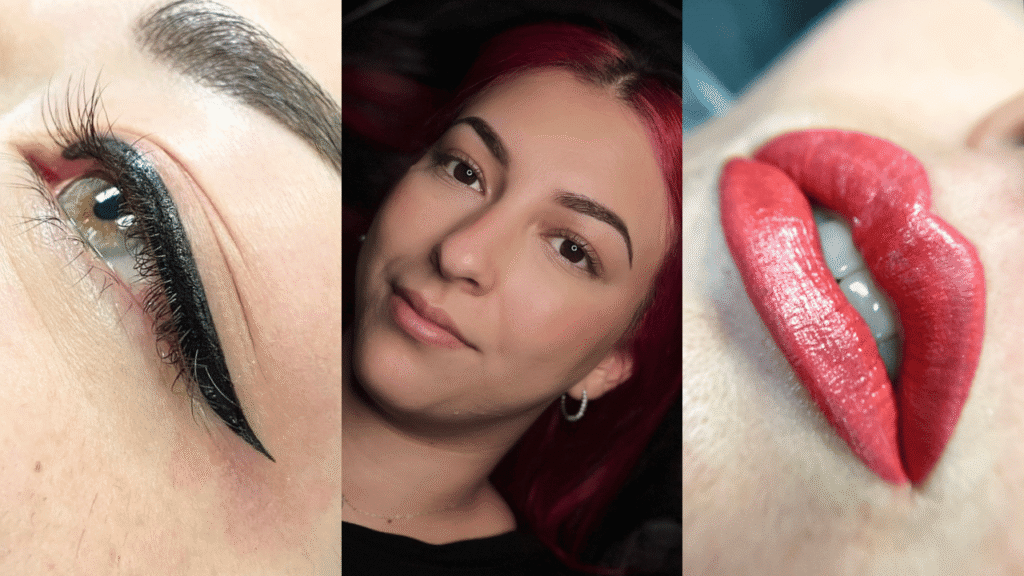
Thinking about getting permanent makeup?
Before you start scrolling through Instagram, saving a hundred brow photos, and messaging every artist in your area asking, “How much for brows?” there are a few much more important questions you should be asking first.
And I’m not saying that as a way to scare you out of getting permanent makeup. Quite the opposite.
Permanent makeup can be an amazing investment when the technique, artist, pigment, design, and your skin all make sense together. But permanent makeup is still tattooing. You are putting pigment into your skin, and the results can last for years.
So before you worry about the price, the appointment date, or whether an artist has the exact brow shape you saved on Pinterest, let’s talk about what you should actually be asking.
As someone who has been doing permanent makeup for years, I would much rather have a client ask me a hundred questions before their appointment than sit in my chair afterward wishing they had.
What Does the Artist’s Work Look Like Healed?
This is probably one of the biggest questions you should be asking before getting permanent makeup.
Not what their work looks like immediately after the appointment.
What does it look like healed?
Fresh permanent makeup can look dramatically different from healed permanent makeup. Right after a procedure, pigment can appear darker, sharper, more saturated, and more defined than it will once the skin has gone through the healing process.
That fresh photo on Instagram might look amazing, but it doesn’t tell you the whole story.
You want to see healed results.
And I don’t mean one healed photo buried somewhere in an artist’s feed.
Look for multiple healed examples from different clients. Look at brows, eyeliner, or lips after they’ve actually healed. Pay attention to how the color looks, how the pigment has settled, how crisp or soft the work is, and whether the artist’s healed results match the style you’re actually looking for.
Check out our permanent makeup services!
What About Healed Results One to Three Years Later?
This is where I’d take the question one step further.
Ask your artist what their work looks like one, two, or even three years down the road.
Permanent makeup fades. That’s normal.
The goal isn’t necessarily for your permanent makeup to look exactly the same forever. Your skin changes, pigment fades, and eventually most clients will need some type of maintenance or refresh if they want to continue wearing the procedure.
But how that pigment fades matters.
Does it soften evenly?
Does the color remain appropriate?
Does the work become blurry?
Does it leave behind a heavy amount of pigment?
Does the artist understand how their technique and pigment choices behave over time?
These are much more important questions than simply asking how long permanent makeup “lasts.”
There isn’t one magic expiration date for permanent makeup because so many factors affect longevity.
Your skin, lifestyle, skincare routine, sun exposure, pigment, technique, placement, and how your body responds can all play a role.
So when you’re interviewing an artist, don’t just ask, “How long does it last?”
Ask, “What should I expect this to look like as it fades?”
That’s a much better question.
Is the Style You Want Actually Right for Your Skin?
Here’s where things get really important.
Just because you like a particular permanent makeup technique doesn’t necessarily mean that technique is the best choice for your skin.
And a good artist should be willing to tell you that.
If you walk into my studio asking for a specific technique and I don’t think your skin is a good candidate for it, I’m going to tell you.
That’s not me trying to change your mind.
That’s me doing my job.
Permanent makeup isn’t one-size-fits-all.
Two people can ask for the exact same brow style and require completely different approaches because their skin is completely different.
This is especially important when you’re comparing techniques like microblading and machine hairstrokes.
Microblading vs. Machine Hairstrokes
A lot of clients think these are basically two names for the same thing.
They’re not.
Microblading uses a manual tool with blades to create hairstroke-style marks in the skin. Machine hairstrokes are created using a permanent makeup machine and needle configuration.
Visually, the goal can be similar: creating the appearance of individual brow hairs.
But the way the skin is approached is different.
And that matters.
Some skin types may not be ideal for microblading. Some clients may not be ideal candidates for machine hairstrokes either. Other clients may have skin that can handle one technique much better than another.
This is exactly why I don’t think you should choose a technique solely because you saw a picture of it online and liked the way it looked.
The better question is:
“Which technique is going to work best for my skin?”
Your artist should be looking at your actual skin, not just showing you a menu of techniques and letting you pick one like you’re ordering lunch.
What Happens If I’m Not a Good Candidate for the Technique I Want?
This is another question I wish more clients asked.
Let’s say you come in wanting microblading, but your artist looks at your skin and doesn’t think it’s the best option.
What happens next?
A good consultation shouldn’t end with, “No, you can’t have that.”
There should be a conversation about why.
Maybe another technique would be more appropriate.
Maybe a machine brow would be a better option.
Maybe a different style of permanent makeup would give you a better healed result.
Or maybe permanent makeup isn’t the right choice for you at all.
Yes, sometimes that’s the answer.
And honestly, I’d rather tell someone not to get a procedure than perform something I don’t believe is going to give them a good long-term result.
That’s part of being a professional.
What Will My Permanent Makeup Look Like After It Heals?
Don’t be afraid to ask your artist to explain the healing process before you book.
You should know that permanent makeup doesn’t simply look exactly the same from the moment you leave the studio until the day you need a refresh.
There is a healing period.
Depending on the procedure, you may experience changes in color and appearance as the skin heals and the pigment settles.
Your artist should be able to explain what is normal, what you should expect, what your aftercare looks like, and when you should contact them if something doesn’t seem right.
Don’t be afraid to ask:
“What should I expect during healing?”
“What will the color look like once it’s healed?”
“What should I avoid while it’s healing?”
“When should I expect my final result?”
These questions can save you a lot of unnecessary stress later.
What Is the Upkeep of Permanent Makeup?
Permanent makeup is not necessarily a “get it done once and forget about it forever” procedure.
It fades.
That’s part of the process.
How quickly it fades can vary from person to person, and your artist should be honest with you about that.
Your skincare routine can matter. Sun exposure can matter. Your skin type can matter. Your lifestyle can matter. The technique used can matter.
If you’re someone who spends a lot of time in the sun, uses certain active skincare products, or has oily skin, those are things worth discussing with your artist.
Ask:
“What kind of maintenance will I need?”
And more importantly:
“What happens when it starts fading?”
You want to understand whether you’ll eventually need a color refresh, how often your artist recommends maintenance, and what happens if you decide you don’t want to continue refreshing it.
What Pigments Does the Artist Use?
You don’t necessarily need to become a pigment expert before getting permanent makeup.
But I do think it’s reasonable to ask your artist what products they use and how they approach color selection.
Permanent makeup artists aren’t just picking a color because it looks pretty in a bottle.
Your artist should be considering your skin tone, undertones, existing pigment, desired result, and the specific procedure being performed.
And if you’re getting a correction or working over old permanent makeup, that’s an entirely different conversation.
Old pigment can affect what an artist is able to create.
Sometimes the best next step isn’t simply putting a new color over the old one.
Does the Artist Have Experience With Corrections?
This is especially important if you already have old permanent makeup.
If you have faded brows, gray brows, red or orange pigment, overly dark brows, uneven work, or old permanent makeup that you’re unhappy with, don’t assume every artist who offers brows is experienced in correcting them.
Correction is its own skill set.
Your artist should be able to look at what you currently have and explain what they think is realistic.
Sometimes correction is possible.
Sometimes lightening or removal may be recommended first.
And sometimes the best answer is to leave it alone until the existing pigment fades further.
You don’t want an artist who simply sees old pigment and thinks, “I can cover that.”
You want someone who understands what’s already in the skin.
Get more information on our corrections and removals!
How Long Has the Artist Been Doing Permanent Makeup?
Experience isn’t everything, but it absolutely matters.
Ask how long they’ve been performing the specific procedure you’re interested in.
Someone may have been doing permanent makeup for several years but only recently started offering eyeliner, lips, or a particular brow technique.
That’s worth knowing.
You can also ask about their training, continuing education, and whether they specialize in the service you’re considering.
And please don’t make your decision based solely on someone’s follower count.
A giant Instagram following doesn’t automatically mean someone is the right artist for you.
Look at the work.
Look at the healed work.
Look at their experience.
Look at how they communicate.
And pay attention to whether they are actually answering your questions.
What Happens During the Consultation?
A consultation shouldn’t feel like you’re being rushed through a sales pitch.
You should have the opportunity to talk about what you want, what you’re concerned about, your skin, your previous permanent makeup if you have any, and what kind of result you’re hoping to achieve.
You should also be able to ask questions about the procedure, healing, maintenance, and whether you’re a good candidate.
At Ms Amber Red Studio, consultations are free because I genuinely believe that education matters.
Even if you don’t end up booking with us, I’d rather you walk away knowing more than you did when you walked through the door.
If we can help you make a better decision for your skin and your goals, that’s a win.
Book a free consultation here!
Don’t Be Afraid to Ask an Artist Questions
I know sometimes people feel awkward asking too many questions.
Don’t.
This is your face.
You’re not being annoying by asking how the procedure works, what technique is being used, what the healed result will look like, or what happens if you’re not a good candidate.
Those are exactly the questions you should be asking.
And if an artist gets irritated because you’re asking reasonable questions about a procedure that will be implanted into your skin and can last for years?
That’s information too.
Pay attention to how an artist communicates with you before you ever sit in their chair.
You should feel comfortable asking questions.
You should feel like your concerns are being heard.
And you should feel like the artist is making recommendations based on you, not simply trying to sell you the service you originally asked for.
Don’t Choose Your Permanent Makeup Artist Based on Price Alone
I know price matters.
Of course it does.
But permanent makeup isn’t something I recommend shopping for like you’re comparing prices on a pair of shoes.
The cheapest artist isn’t necessarily the best choice.
The most expensive artist isn’t automatically the best choice either.
Look at the entire picture.
Look at their experience. Look at healed results. Look at their technique. Look at their communication. Look at their studio. Look at their reviews. Look at how they handle consultations. Look at whether they are willing to tell you when something isn’t appropriate for your skin.
You aren’t just paying for the hour or two you’re sitting in the chair.
You’re paying for the artist’s experience, knowledge, technique, judgment, and ability to create a result that makes sense for you.
The Right Permanent Makeup Artist Should Educate You
At the end of the day, this is what I want clients to understand.
You don’t need to walk into your consultation already knowing exactly what technique you want.
You don’t need to know the difference between every needle configuration.
You don’t need to know what pigment you’ll need.
That’s part of why you’re going to a professional.
Your job is to communicate what you want, ask questions, be honest about your expectations, and listen to the recommendations of an experienced artist.
The artist’s job is to evaluate your skin, understand your goals, explain your options, and tell you the truth about what they believe will give you the best result.
Sometimes that means doing exactly what you asked for.
Sometimes it means modifying the plan.
And sometimes it means telling you that another option would be better.
That’s what you want.
You don’t want someone who says yes to everything.
You want someone who knows when to say no.
Before You Book Your Permanent Makeup Appointment
So before you start looking for “permanent makeup near me” or booking the first artist whose Instagram catches your attention, slow down for a minute.
Look at healed work.
Ask what the artist’s results look like one to three years later.
Ask whether the technique you’re interested in is appropriate for your skin type.
Ask about healing and aftercare.
Ask about maintenance.
Ask about pigment.
Ask about their experience.
Ask what happens if you’re not a good candidate.
And if you already have old permanent makeup, ask how the artist plans to approach what’s already there before agreeing to put more pigment into your skin.
Permanent makeup can be an incredible service when it’s done thoughtfully and appropriately.
But the best results don’t start when the artist picks up the machine.
They start with the consultation.
And that’s why I always tell clients: ask the questions.
Ask the uncomfortable questions. Ask the “maybe this is stupid” questions. Ask the questions you found on Google at 2 a.m.
I’d rather educate you now than have you regret not asking later.