
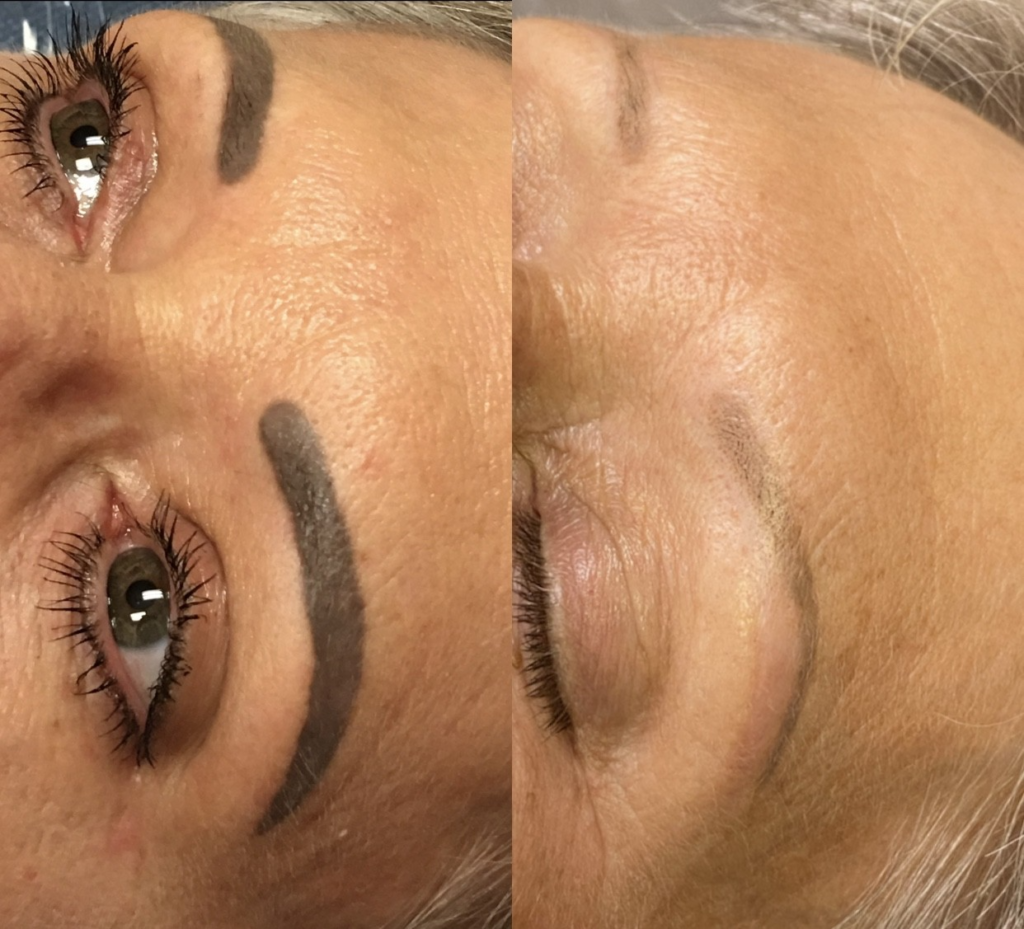
You looked in the mirror and thought:
“Why the hell are my eyebrows GRAY?!”
Maybe your microblading looked beautiful when you first had it done. Maybe it was years ago and slowly started changing. Or maybe you recently had your brows touched up and now you’re noticing that they look gray, blue, ashy, or just… off.
First, take a breath.
Gray permanent eyebrows don’t automatically mean your brows are ruined. But they also don’t mean you should immediately have someone slap an orange pigment over them and call it a day.
There can be a lot more going on underneath the surface.
As a Las Vegas permanent makeup artist and correction specialist, I’ve seen plenty of old microblading and permanent eyebrows that have changed color over time. And one of the biggest mistakes I see is trying to correct the color you see without figuring out why it’s there in the first place.
So let’s talk about what’s actually happening with those gray brows.
Why Did My Microblading Turn Gray?
First things first: your pigment may not have literally “turned gray.”
I know. That sounds weird because you’re looking at your eyebrows and they’re clearly gray.
But permanent makeup is sitting inside your skin, and what you see on the surface is affected by several things, including:
- The original pigment that was used
- Your natural skin tone and undertone
- How deep the pigment was implanted
- How much pigment was implanted
- How your skin healed
- How the pigment has faded over time
- Sun exposure
- Skincare products and treatments
- Previous touch-ups
- Other permanent makeup that was layered over it
As permanent makeup ages, some pigment colors can fade faster than others.
That can leave behind a cooler, ashier, grayish, blue-gray, or even slightly greenish appearance.
So when you look at your brows and think, “My brown eyebrows turned gray,” what you’re actually seeing may be the remaining pigment underneath your skin after years of fading and color changes.
And that’s important because the solution isn’t always as simple as adding more color.
Okay… So Can You Just Put Brown or Orange Over It?
This is where things get interesting.
You’ve probably heard about color correction and maybe even been told that orange will cancel out gray.
And yes, certain colors can be used strategically to shift unwanted tones.
But your brows aren’t a color-by-number project.
If someone looks at your gray brows and immediately says, “Yep, we’ll just put orange over that,” I’d slow down.
Because orange pigment doesn’t magically erase what’s already underneath your skin.
It doesn’t remove old pigment.
It doesn’t fix an unwanted brow shape.
It doesn’t undo years of previous touch-ups.
And it doesn’t automatically make heavily saturated or deeply implanted pigment disappear.
Sometimes adding another layer of pigment is exactly what makes the situation harder to correct later.
Why Are My Old Permanent Eyebrows So Dark or Gray?
One major factor is how deeply the original pigment was implanted.
Permanent makeup is supposed to be placed into the skin at a controlled depth.
When pigment is implanted too deeply, the healed result can look darker, blurrier, or cooler than intended.
Over time, that can become even more noticeable.
And then there’s another common issue:
Touch-ups.
If you’ve had your brows touched up over and over again, you’re adding more pigment to an area that already contains pigment.
Eventually, you can end up with several layers of old permanent makeup.
That doesn’t necessarily mean your previous artist did something terrible. Techniques, pigments, machines, and industry knowledge have changed a LOT over the years.
But it does mean your brows may require a different approach now.
Your Skin Matters, Too
Here’s something clients don’t always realize:
Permanent makeup doesn’t exist separately from your skin.
Your skin is part of the equation.
Your skin type, natural undertone, healing, oil production, sun exposure, and even the skincare treatments you use can influence how your permanent makeup ages.
Things like:
- Retinoids
- Exfoliating acids
- Chemical peels
- Resurfacing treatments
- Excessive sun exposure
- Certain skin treatments
can all affect the appearance and longevity of permanent makeup over time.
That’s one reason two people can have the same pigment implanted by the same artist and have completely different healed results years later.
Your skin gets the final say.
Does Gray Microblading Mean I Need Removal?
Not necessarily.
This is probably one of the most important things I want you to take away from this.
Gray brows don’t automatically mean you need to remove them.
Sometimes color correction can be appropriate.
Sometimes your existing pigment is light enough that a new brow can be created over it.
And sometimes the smartest move is actually to lighten some of the old pigment first.
It all depends on what you’re working with.
Color correction may be an option if:
- Your existing brow shape is still something you like
- The pigment isn’t extremely dark
- Your brows aren’t heavily saturated
- Your skin is healthy
- There’s enough room to safely work with the existing pigment
- The underlying color can realistically be shifted
But if the pigment is very dark, dense, blurry, heavily layered, or sitting in an unwanted shape, adding more pigment may not be the best answer.
That’s when lightening or removal may make more sense.
What If My Brows Are Really Dark and Blurry?
This is where I want you to be careful.
If your old permanent eyebrows are extremely dark, gray, blue-gray, blurry, or outside the shape you actually want, covering them with more permanent makeup isn’t necessarily going to make the problem disappear.
You may temporarily see a different color.
But the old pigment is still underneath.
And now you’ve potentially added another layer on top of it.
That’s why sometimes the best correction is actually doing less first.
Depending on your situation, a professional may recommend lightening the old pigment before attempting a new brow.
At my Las Vegas studio, I offer LiFT saline tattoo lightening/removal for appropriate cases. The goal isn’t to remove everyone’s brows just because they’re old or gray. It’s about creating a better starting point when the existing pigment is preventing us from getting the result you actually want.
Can Gray Microblading Be Fixed?
In many cases, yes.
But “fixed” doesn’t always mean the same thing for everyone.
Your options could include:
Color correction:
The existing pigment may be suitable for a color correction procedure that shifts the unwanted tone.
Lightening:
If there’s too much old pigment, lightening may help create more room for a future brow.
Removal:
In some situations, removal or multiple lightening sessions may be the better path.
New permanent makeup:
If the existing pigment is light enough and the shape is workable, a new brow may be possible without removal.
Waiting:
Sometimes the best answer is to let your skin heal or allow existing pigment to fade further before doing anything else.
And that’s exactly why I don’t recommend choosing your solution based solely on what your brows look like in a bathroom mirror.
What Should I Do If My Microblading Turned Gray?
First: don’t panic.
Second: don’t immediately book another brow appointment with someone who promises to cover it.
And definitely don’t assume that because someone says they can “fix the color” that they’re automatically equipped to handle a correction.
Permanent makeup correction requires looking at the entire picture.
I want to know:
- How old is your existing permanent makeup?
- What procedure did you originally have?
- How many times has it been touched up?
- What pigments were used, if you know?
- How dark is the existing pigment?
- Is the shape something you still like?
- Is the pigment blurry?
- How has your skin healed?
- What does the pigment look like in person?
- How much pigment is actually sitting in the skin?
A photo can give me an idea, but an in-person assessment gives me much more information.
Don’t Let Someone Tattoo Over Your Brows Just Because You’re Frustrated
I completely understand why you’re tempted.
You’ve been staring at gray brows for months or years, and you just want your eyebrows to look normal again.
You find someone online who says:
“I can fix those!”
And suddenly you’re ready to book.
But permanent makeup correction isn’t the time to rush.
If the first solution doesn’t work, you could end up with more pigment, more saturation, and fewer options.
Sometimes the smartest correction starts with figuring out what not to do.
That’s especially true when you’re dealing with old microblading, gray permanent eyebrows, previous color corrections, or multiple layers of PMU.
So… What’s the Best Solution for My Gray Brows?
Honestly?
It depends.
There isn’t one magic pigment that fixes every gray eyebrow.
There isn’t one correction formula that works for every client.
And there isn’t one answer that applies to every set of old microblading.
Your brows need to be evaluated based on what’s actually in your skin—not just what color you’re seeing on top.
And that’s something I take seriously when I’m working with permanent makeup corrections in Las Vegas.
My goal isn’t to convince you that you need another procedure.
Sometimes you do.
Sometimes you need color correction.
Sometimes you need lightening.
Sometimes you need removal.
And sometimes I may tell you to leave them alone for now.
The goal is to figure out which option gives you the best chance of getting the brows you actually want without making the situation harder.
Ready to Figure Out What’s Going On With Your Gray Brows?
If you’re sitting there staring at your eyebrows thinking, “Okay… but what the hell do I do now?”—that’s exactly what a correction consultation is for.
Bring me your brows.
We’ll look at the existing pigment, shape, saturation, skin, and overall condition and figure out what actually makes sense.
You may be a good candidate for color correction.
You may need some pigment lightened first.
You may be ready for new permanent makeup.
Or we may decide that waiting is your best move.
There is no one-size-fits-all answer when it comes to permanent makeup correction.
And honestly, that’s a good thing.
Because your brows aren’t a color-by-number project.
Let’s figure out what’s actually going on first.
Book a free consultation with Ms Amber Red here!